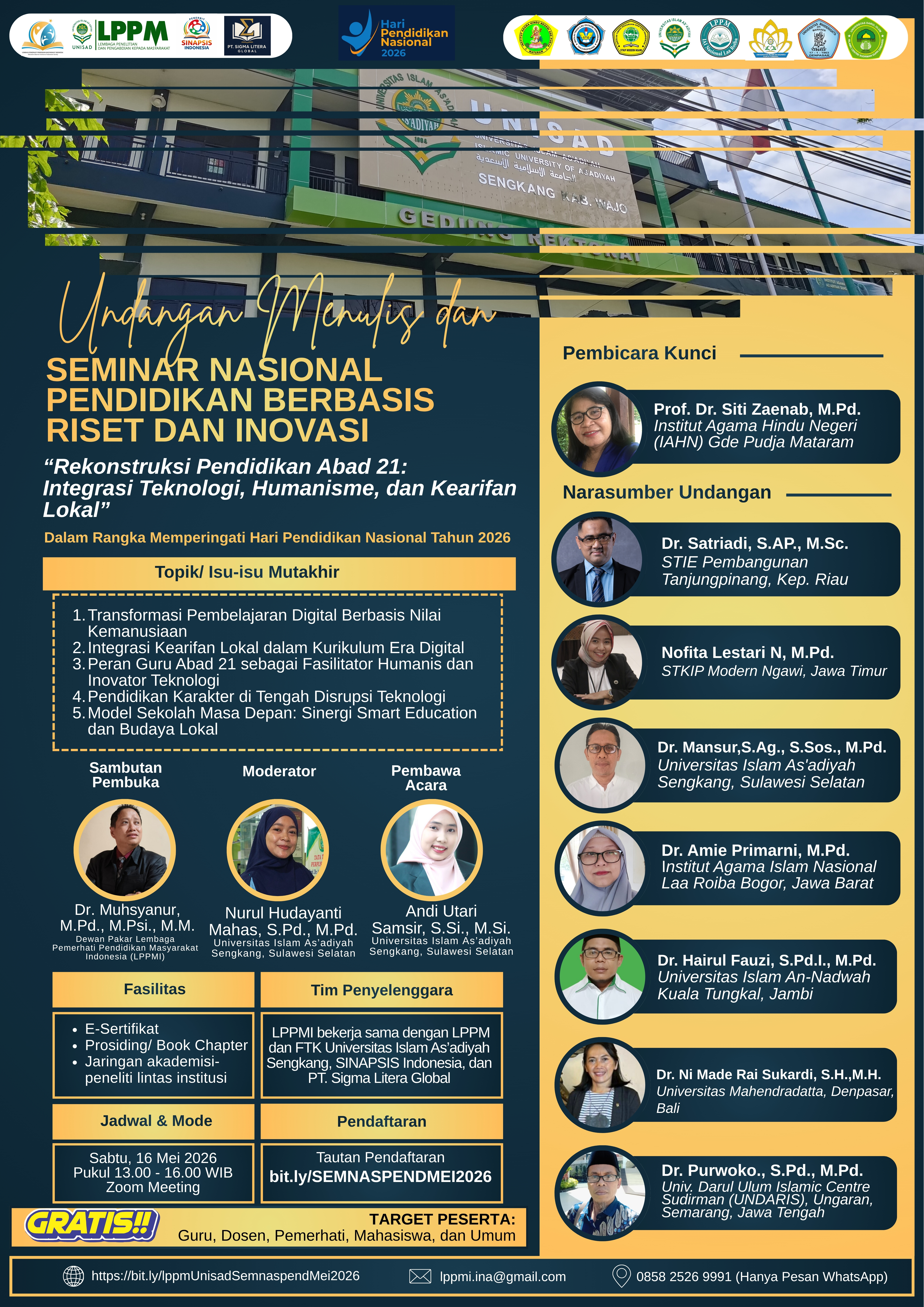
Rekonstruksi Pendidikan Abad 21: Integrasi Teknologi Digital, Nilai Humanisme, dan Kearifan Lokal
Reconstructing Education in the 21st Century: Integration of Digital Technology, Humanism Values, and Local Wisdom
Keywords:
education reconstruction; digital technologies; humanism; local knowledge; 21st centuryAbstract
21st century education faces major challenges due to massive digital disruption. The reconstruction of education is an inevitable necessity in order to answer the demands of the times without losing the nation's identity. This paper aims to examine the importance of harmonious integration between digital technology, humanistic values, and local wisdom in the Indonesian education system. The approach used is a conceptual study with reference to the thoughts of Ki Hadjar Dewantara, John Dewey, Theodore Brameld, and Abraham Maslow and Carl Rogers. The results of the study show that digital technology should be an instrument that strengthens, not replaces, human capacity. The values of humanism, empathy, ethics, and character are the foundation so that students are not only technically skilled, but also morally mature. Local wisdom plays a role in maintaining cultural identity in the midst of globalization. The conclusion emphasizes that successful education reconstruction requires the synergy of the three dimensions in a complete, planned, and sustainable manner in order to produce a generation with a global perspective but a local character.
References
Banks, J. A. (2016). Cultural diversity and education: Foundations, curriculum, and teaching (6th ed.). Routledge. https://doi.org/10.4324/9781315622255
Battiste, M. (2017). Decolonizing education: Nourishing the learning spirit. Purich Press.
Biesta, G. (2022). World-centred education: A view for the present. Journal of Philosophy of Education, 56(1), 1–16. https://doi.org/10.1111/1467-9752.12657
Darling-Hammond, L., Flook, L., Cook-Harvey, C., Barron, B., & Osher, D. (2020). Implications for educational practice of the science of learning and development. Applied Developmental Science, 24(2), 97–140. https://doi.org/10.1080/10888691.2018.1537791
Facer, K. (2019). Storytelling in troubled times: What is the role for educators in the deep crises of the twenty-first century? Literacy, 53(1), 3–13. https://doi.org/10.1111/lit.12179
Holmes, W., Bialik, M., & Fadel, C. (2019). Artificial intelligence in education: Promises and implications for teaching and learning. Center for Curriculum Redesign.
Jonassen, D. H., & Rohrer-Murphy, L. (2019). Activity theory as a framework for designing constructivist learning environments. Educational Technology Research and Development, 67(4), 1–22. https://doi.org/10.1007/s11423-019-09680-3
Lickona, T. (2019). How to raise kind kids: And get respect, gratitude, and a happier family in the bargain. Penguin Books.
Loyens, S. M. M., & Rikers, R. M. J. P. (2011). Instruction based on inquiry. In R. E. Mayer & P. A. Alexander (Eds.), Handbook of research on learning and instruction (pp. 361–381). Routledge.
Noddings, N. (2015). The challenge to care in schools: An alternative approach to education (2nd ed.). Teachers College Press.
Resta, P., & Laferrière, T. (2015). Digital equity and intercultural education. Education and Information Technologies, 20(4), 743–756. https://doi.org/10.1007/s10639-015-9419-z
Ribble, M. (2015). Digital citizenship in schools: Nine elements all students should know (3rd ed.). International Society for Technology in Education.
Selwyn, N. (2019). Should robots replace teachers? AI and the future of education. Polity Press.
Smith, L. T. (2021). Decolonizing methodologies: Research and indigenous peoples (3rd ed.). Zed Books.
Tilaar, H. A. R. (2015). Pedagogik teoritis untuk Indonesia. Penerbit Buku Kompas.
Twenge, J. M., Joiner, T. E., Rogers, M. L., & Martin, G. N. (2018). Increases in depressive symptoms, suicide-related outcomes, and suicide rates among U.S. adolescents after 2010 and links to increased new media screen time. Clinical Psychological Science, 6(1), 3–17. https://doi.org/10.1177/2167702617723376
UNESCO. (2023). Technology in education: A tool on whose terms? (Global Education Monitoring Report 2023). UNESCO Publishing. https://doi.org/10.54676/UZQV8501